
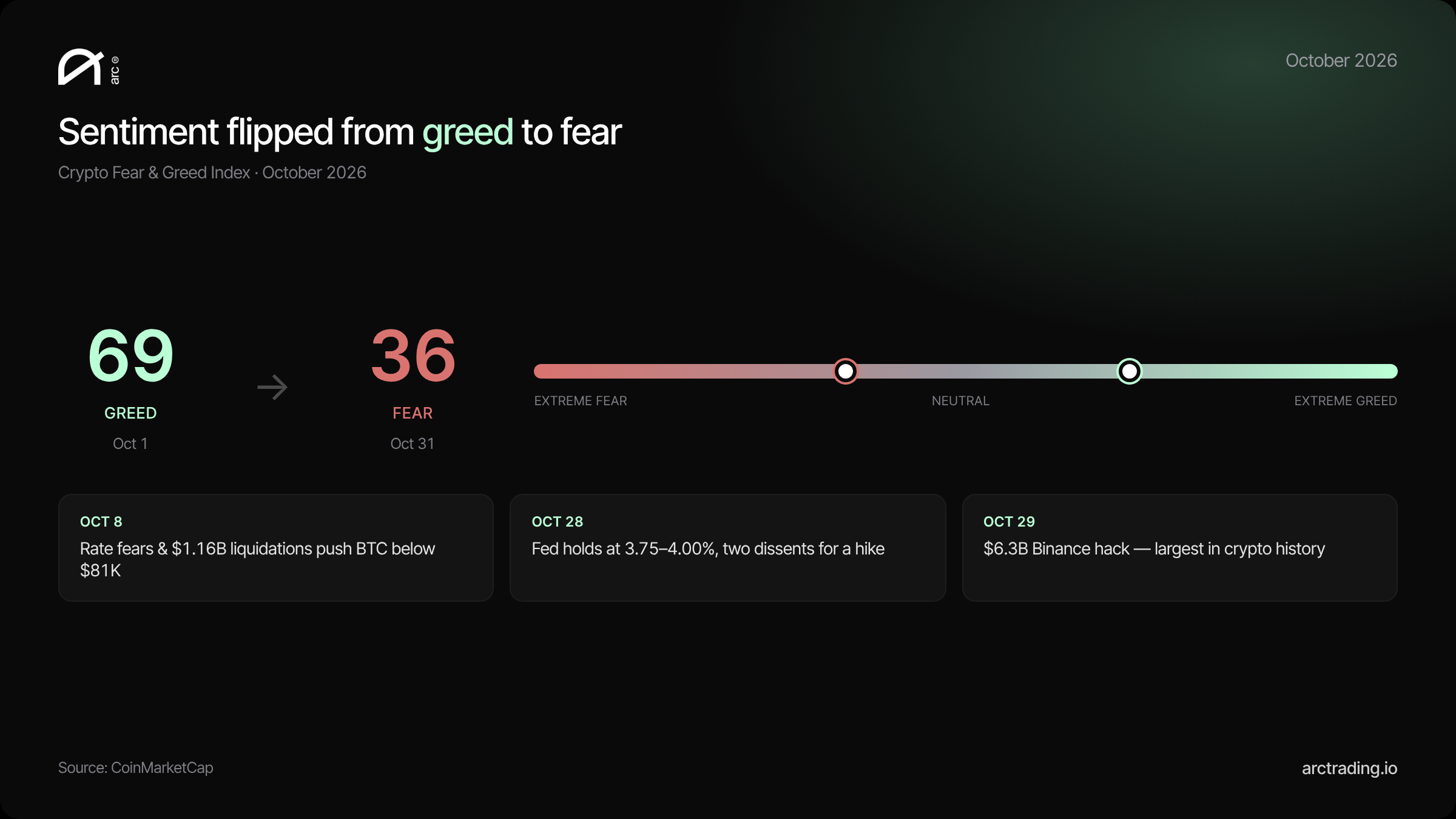
For four months the story was crypto pulling away from everything else — holding through war headlines, a chip-market collapse, even a Fed hike. In October that decoupling closed. Bitcoin’s correlation to equities climbed back, risk-on broke, and when the selling came crypto caught the full downside instead of dodging it. BTC fell 7.3% to $77,441, Ether lost 16%, and 92% of the top 100 ended the month red — the weakest breadth of 2026. Then, on the second-to-last day, the largest exchange hack in history landed on top.
TL;DR
- The crypto market fell ~9% in October, its worst month of the year. BTC dropped 7.3% to $77,441; ETH lost 16%; only Monero and LEO finished green among the top 20.
- Risk-on broke on sticky inflation and rising rates — September CPI hit 3.7%, the 10-year pushed toward multi-decade highs, and Fed minutes dropped any mention of cuts.
- Bitcoin’s correlation to equities returned after two months of decoupling, flipping crypto back into a high-beta, negative-skew expression of the AI-heavy equity tape.
- The ETF bid inverted: spot BTC ETFs saw ~$514M of outflows after two months of strong inflows, with ETH ETFs losing ~$1.6B.
- The $6.3B Binance hack on October 29 — the largest crypto theft ever — accelerated the selloff in the final days, triggering ~$1.5B in liquidations.
Risk-On Breaks
September ended with crypto reclaiming its 50-week average for the first time in nearly a year and the burden of proof shifting to the bears. October handed the bears everything they needed.
The macro turned first. September CPI rose to 3.7% from 3.4%, with core hotter than expected — the sign that energy was spilling into the broader basket rather than staying contained. The 10-year yield pushed toward 5.35%, its highest since 2008, with the long end steepening as the bond market repriced a Fed that was tightening, not easing. When the FOMC minutes landed, they showed most officials expecting another hike by year-end and cuts mentioned nowhere. The debate had moved from when the Fed eases to how far it tightens.
That’s the setup crypto couldn’t withstand. A market that spent the summer climbing on the hope of eventual easing met the opposite, and the level that had defined it gave way. BTC traded $82.5K as support for three weeks — the old resistance it had flipped on the way up — then lost it, tested $80K repeatedly, and broke lower into month-end. The October high of $86,513 on the 5th was as good as it got.
The Correlation Comes Back
The deeper story is why the break hit crypto so hard, and it comes down to a relationship that had gone quiet for two months.
Through August and September, BTC decoupled from equities — that was the whole bull case, capital leaving exhausted AI names and finding a home in crypto. In October the correlation climbed back. And in high-correlation regimes, BTC doesn’t behave like a hedge; it trades as a high-beta version of the equity tape with a negative skew, falling harder when stocks drop while rarely matching them on the way up. The alibi that let crypto hold through earlier shocks was gone.
What made it worse is what crypto is now correlated to. The equity market has become reflexive and heavily levered to a single trade: margin debt hit a record $1.5T, and roughly 85% of leveraged ETF assets sit in tech, AI, and semiconductors. When Intel fell ~29% on weak guidance and AI-capex doubts resurfaced — negative free-cash-flow turns, heavy debt issuance, rising power costs — the selloff in the most crowded trade on Wall Street fed straight into crypto. For most of the year the marginal dollar chose AI equities over crypto; in October it was forced to sell both.
The Binance Hack
The month’s defining shock wasn’t macro. On October 29, attackers drained about $6.3B from Binance — the largest crypto theft on record — in an attack attributed to the North Korea-linked TraderTraitor group. Binance paused deposits and withdrawals, pledged to cover losses from company funds, and roughly $3B was frozen.
The hack didn’t start the selloff — the market was already soft on rates and the AI unwind — but it accelerated it in the final days. Because the dips on the majors had been bought mainly through leveraged perps rather than spot, there was no real bid underneath: roughly $1.5B in positions liquidated in 24 hours, about 85% of them longs.
The context matters as much as the number. October saw 35 hack incidents worth $6.5B — more stolen in one month than in all of 2025. And as with the Drift and Kelp exploits earlier this year, the damage came through keys and infrastructure, not flawed smart-contract code. The pattern we flagged in the spring held: as contract code hardens, attackers keep moving up the stack to operational security and the humans behind it. Each incident like this quietly strengthens the custody-and-wrapper pitch to institutions already choosing ETFs over keys.
The ETF Bid Inverts
The institutional flow that was the backbone of the August-September rally reversed, and the price followed it almost exactly.
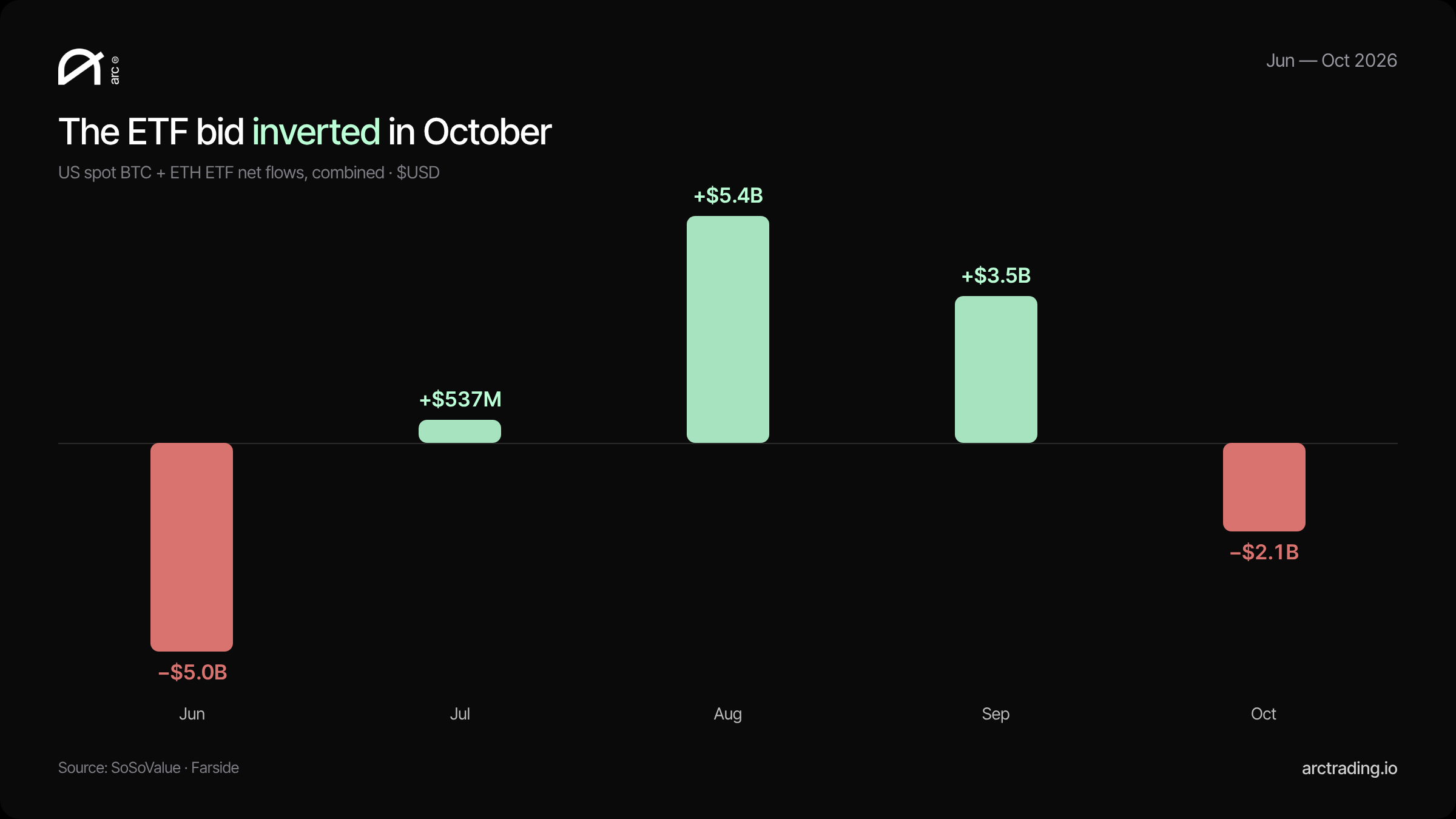
Spot BTC ETFs recorded roughly $514M in net outflows for October, after pulling in $3.52B in August and $2.65B in September. Ether ETFs were worse, shedding about $1.6B, for combined outflows north of $2.1B. The single largest daily outflow since June — $636M — landed on a day the Nasdaq fell, underlining how tightly the wrapper bid had re-coupled to equities. Stablecoin supply shrank by $7.5B on the month, which is the clearest read of all: the money that sits on the sidelines waiting to buy was leaving, not building.
This is the same causal mechanism we’ve tracked all year, confirmed now in the other direction. When the ETF bid arrives, crypto rises on it; when it leaves, there’s nothing underneath. In October it left.
Alts Bleed, Bitcoin Holds Up Best
September was the strongest breadth month of the year, with 91% of tracked tokens positive. October inverted it almost perfectly: 92% finished red, with the average token down about 15% and the median down 17%.
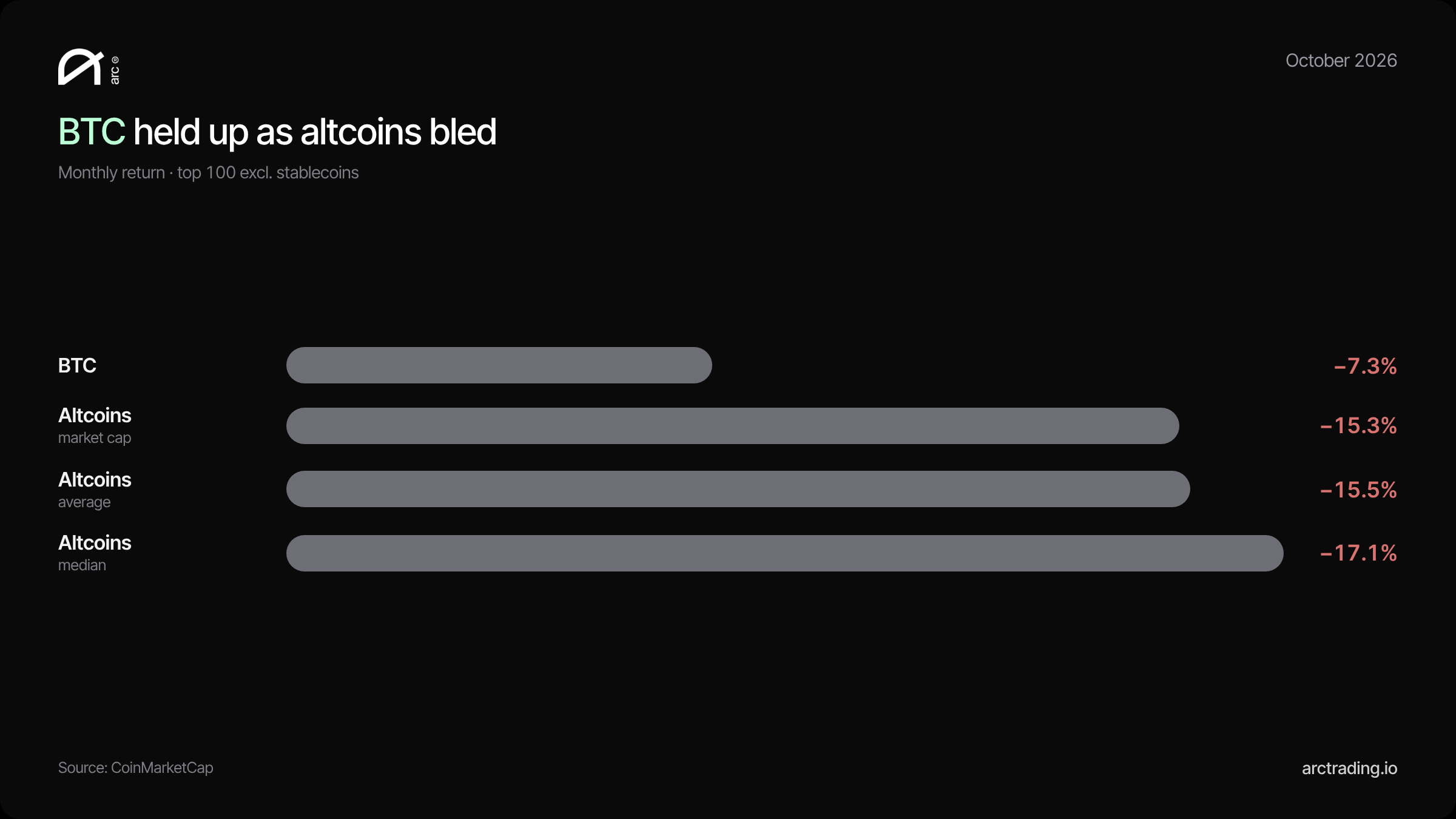
Bitcoin held up best in relative terms, and its dominance rose from 58.6% to 59.8% — the familiar flight into BTC when the market takes a shock, with weaker alts falling two or three times as hard. Ether lost 16%, its second-worst October since 2016, ending a three-month winning streak. Solana fell 19%, and the broader large-cap complex — Stellar, Cardano, Avalanche — dropped 20-25%. The only green among the majors was privacy, with Monero extending its run as capital concentrated in the handful of narratives with demand of their own. Tokenized equities and on-chain trading-card marketplaces were the structural exceptions that kept building through the weakness, a reminder that the quiet adoption layer keeps compounding regardless of price.
Where Things Stand
October was the first clearly negative month in this series since the spring, and it’s worth being straight about what changed. The constructive case we’d carried since June — equity exhaustion feeding a crypto bid, flows confirming, the 50-week reclaimed — ran in reverse. Correlation came back, the bid inverted, and the Binance hack did the rest. The burden of proof has shifted back to the bulls.
What hasn’t changed is the structural backdrop, and that’s the reason this still reads as a correction rather than a regime break. By most cycle measures the market is early: BTC’s drawdown remains far shallower than prior bears at the same point, long-term holders are still accumulating, and the adoption layer — ETFs, tokenization, institutional rails — kept building through a red month. One hack, however large, and one hot CPI don’t undo that.
The line that matters now is the 50-week moving average near $76.8K — the level that acted as resistance through every prior bear and got reclaimed in September. Holding it keeps the cycle-reset thesis alive; losing it on sustained outflows is what would turn this from a correction into something worse. The tells into November: whether ETF and stablecoin flows stabilize or keep draining, whether the AI-equity unwind deepens and drags crypto with it, how the December rate decision frames itself, and whether BTC defends that 50-week line. For the first time since the summer, the market has something to prove again.
This article is provided by Arc Trading for informational purposes only. It is not financial, investment, or trading advice, or a recommendation to buy or sell any asset. Digital assets carry significant risk — do your own research before making decisions.